PU organizes seminar on Allama Iqbal's political thought
|
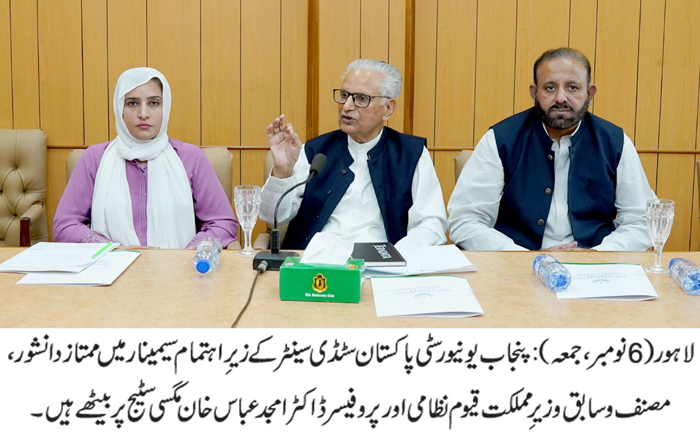
LAHORE: (Friday, November 6, 2026): Punjab University Pakistan Study Centre has organized a seminar titled “Allama Iqbal: Political Thought, Democracy and the Vision of a Progressive Muslim Society” in connection with the commemorations of Allama Muhammad Iqbal. The seminar featured renowned journalist, intellectual, author, and former Minister of State, Qayyum Nizami, as the keynote speaker while Director Pakistan Study Centre Professor Dr. Amjad Abbas Khan Magsi, Assistant Professor Dr. Chaman Hussain, faculty members, researchers, and students attended the event. The seminar aimed to revisit Allama Iqbal’s political and philosophical contributions, particularly his ideas on democracy, selfhood (Khudi), Ijtihad, collective consciousness, and the development of a progressive Muslim society, while examining their relevance to contemporary political and social challenges. In his keynote address, Qayyum Nizami discussed various dimensions of Allama Iqbal’s political philosophy and highlighted the continuing relevance of his ideas in understanding Pakistan’s political and democratic development. He emphasized the need to move beyond the literary interpretation of Iqbal and engage critically with his political vision, particularly his emphasis on intellectual awakening, self-realization, social justice, and collective responsibility. He also reflected on the significance of Iqbal's ideas for contemporary Muslim societies and the challenges facing democratic institutions and political leadership. Prof Dr. Amjad Abbas Khan Magsi highlighted the international recognition of Allama Muhammad Iqbal and the enduring influence of his intellectual contributions beyond South Asia. Referring particularly to countries such as Iran and Germany, he explained how Iqbal's philosophical and literary legacy has received recognition and appreciation internationally. He highlighted the resonance of Iqbal's ideas on selfhood, spirituality, human dignity, and intellectual awakening across different cultural and intellectual traditions. He observed that Iqbal's thought transcends geographical and cultural boundaries and continues to inspire scholarly engagement around the world. He emphasized the importance of introducing Iqbal's intellectual legacy to younger generations through academic research, critical inquiry, and international scholarly dialogue. The seminar was followed by an interactive question-and-answer session. The discussion provided an opportunity for participants to critically reflect on the relevance of Iqbal's ideas in contemporary Pakistan and the wider Muslim world.
Tweet Follow @pu_lhr_official |