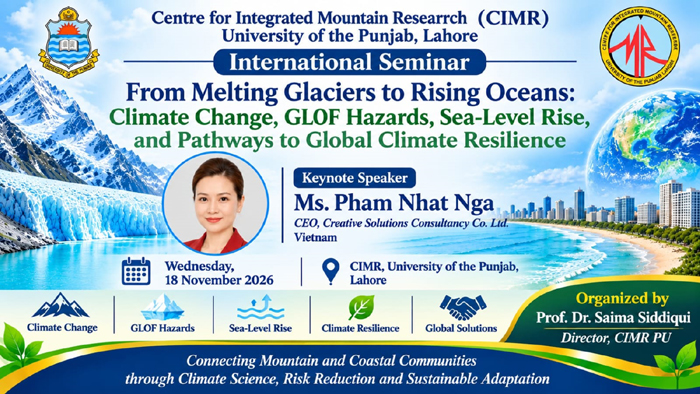
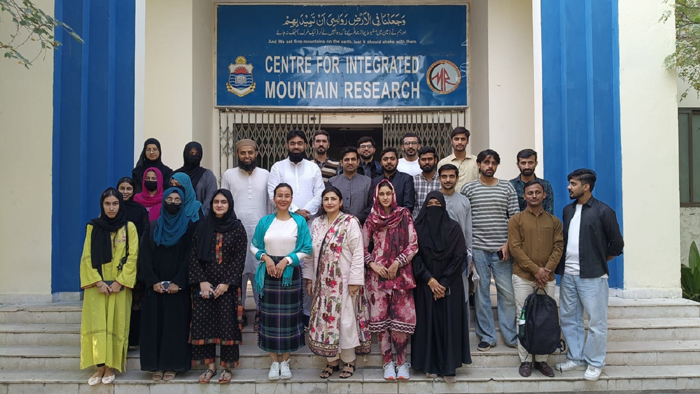
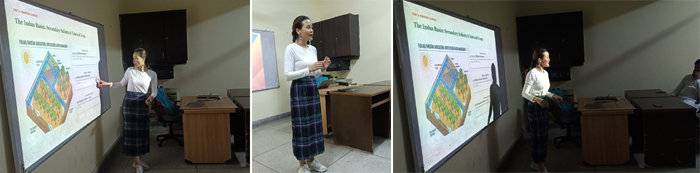
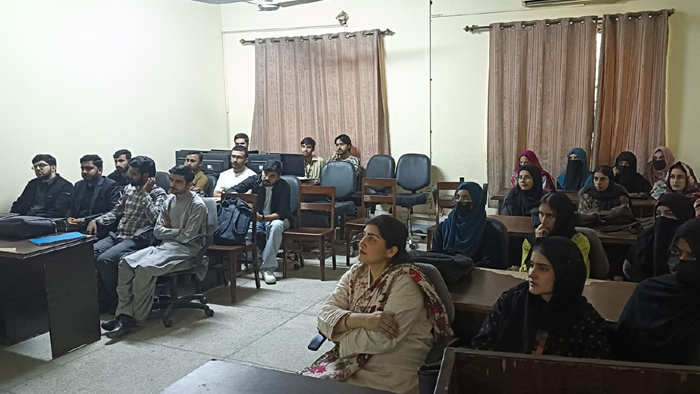
Lahore, Pakistan | 19 November 2026: The Centre for Integrated Mountain Research (CIMR), University of the Punjab, Lahore, organized a one-day international seminar titled “From Melting Glaciers to Rising Oceans: Climate Change, GLOF Hazards, Sea-Level Rise, and Pathways to Global Climate Resilience.” The seminar featured Ms. Pham Nhat Nga from Vietnam as the distinguished speaker. The event was organized under the leadership of Prof. Dr. Saima Siddiqui, Director, CIMR, with the participation of faculty members and students. |
|
During the seminar, Ms. Pham Nhat Nga shared valuable insights into the multifaceted challenges of climate change, emphasizing the growing environmental risks associated with glacier melting, Glacial Lake Outburst Floods (GLOFs), rising sea levels, and climate-induced vulnerabilities. Drawing upon her academic background in Climate Change and Development from Vietnam Japan University, in collaboration with Ibaraki University, Japan, and her extensive professional experience in climate-resilient agriculture, water and natural resource management, and sustainable development, she highlighted the importance of integrated approaches to climate adaptation and resilience. |
|
The speaker also discussed the significance of effective communication, stakeholder engagement, community participation, and climate-informed decision-making in addressing emerging environmental challenges. Her professional engagements with regional development initiatives, the Mekong River Commission Secretariat, the Water and Natural Resource Management (WARM) Facility, and climate-resilient agricultural programmes provided an important practical perspective on translating climate knowledge into sustainable development actions. |
|
The seminar highlighted the interconnected nature of mountain and coastal ecosystems, particularly the consequences of accelerating glacier retreat in high-altitude regions and sea-level rise in vulnerable coastal areas. Discussions also emphasized the importance of scientific research, geospatial technologies, early warning systems, disaster risk reduction, and international collaboration in strengthening climate resilience. |
|
In her remarks, Prof. Dr. Saima Siddiqui, Director CIMR, emphasized the importance of International academic collaboration and knowledge exchange in understanding and addressing the growing impacts of climate change. She highlighted the need to strengthen research, institutional cooperation, and capacity-building to address climate-induced hazards, particularly in vulnerable mountain and coastal regions of Pakistan and beyond. |
The seminar provided an interactive academic platform for faculty members and students to engage with contemporary global climate challenges and explore practical pathways towards climate adaptation, disaster preparedness, and sustainable environmental management. |
Through this initiative, CIMR reaffirmed its commitment to promoting international academic linkages, interdisciplinary research, and knowledge-sharing on climate change, mountain environments, natural hazards, and sustainable development. |
Centre for Integrated Mountain Research (CIMR)
University of the Punjab, Lahore, Pakistan |
|