|
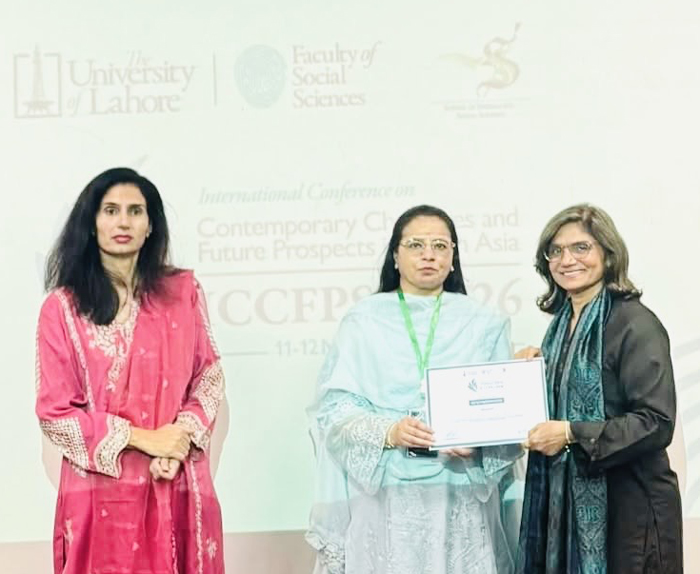
Prof. Dr. Naheed S. Goraya, Director, Centre for South Asian Studies (CSAS), University of the Punjab, Lahore, chaired an academic session at the International Conference on "Contemporary Challenges and Future Prospects in South Asia". The Conference was organized by the School of Integrated Social Sciences (SISS), University of Lahore & took place on 11-12 November 2026.
The session provided an intellectually engaging platform for scholarly deliberations on the evolving geopolitical, strategic, security and domestic political dynamics of South Asia. Bringing together diverse research perspectives, the session examined the complex interplay of regional and extra-regional powers, strategic rivalries, nuclear deterrence, political mobilisation and prospects for regional cooperation.
During her opening remarks, Prof. Dr. Naheed S. Goraya highlighted the strategic significance of South Asia in contemporary international relations, describing it as a region characterised by geopolitical rivalries, unresolved conflicts, nuclear dynamics, emerging regional partnerships and evolving patterns of regional cooperation. Dr. Goraya emphasised that understanding the region's future requires an integrated perspective that takes into account the interaction of global power politics, domestic political developments, security challenges and multilateral engagement.
The academic session featured five research papers addressing key dimensions of contemporary South Asian affairs, titled, "South Asia in the Eurasian Turn: The Role of SCO in Regional Multilateralism", "Strategic Competition and Regional Order in South Asia: Assessing the Role of the United States", "Nuclear Deterrence and Mediation: Security Dynamics of Crisis Management between India and Pakistan (2001–2025)", "Ideological Continuity and Political Pragmatism: JUI-F's Role in Conflict Resolution during the Musharraf Era (1999–2008)", & "The Rise and Emergence of Tehreek-e-Labbaik Pakistan (TLP)".
In her analytical observations, Prof. Dr. Goraya identified three interconnected dimensions emerging from the research presentations: the geopolitical dimension, encompassing the role of regional and global powers; the security dimension, focusing on nuclear deterrence and crisis management; and the domestic political dimension, addressing ideological mobilisation, political pragmatism and state–society relations. She underscored that these dimensions cannot be examined in isolation, as domestic political developments influence foreign policy, external geopolitical competition shapes regional security, and security challenges directly affect the prospects for regional cooperation.
While concluding the session, Dr. Goraya emphasised that sustainable peace in South Asia requires an integrated approach founded on constructive diplomacy, confidence-building measures, stronger regional institutions, sustained political dialogue and a renewed commitment to peaceful coexistence. She observed that military deterrence alone cannot guarantee lasting peace and that meaningful regional cooperation requires institutional mechanisms and political will.
Prof. Goraya appreciated all five researchers for their valuable scholarly contributions and encouraged further critical academic engagement on the challenges and future prospects of South Asia. The session concluded with an interactive discussion involving participants and the audience, providing an opportunity to reflect on realistic pathways towards sustainable peace, strategic stability and institutionalised regional cooperation in South Asia.
|
