Educational emergency in Pakistan, urgent investment needed, Malik Muhammad Ahmad Khan
|
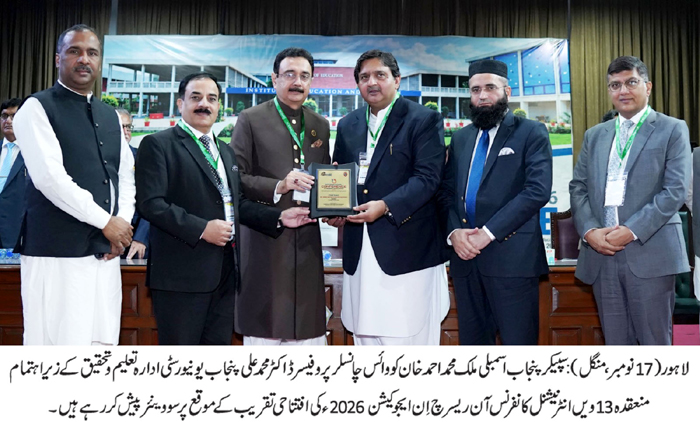
LAHORE: (Tuesday, November 17, 2026): Speaker of the Punjab Assembly, Malik Muhammad Ahmad Khan, has said that the only sustainable path to Pakistan’s development, economic stability, awareness, and social reform lies in promoting quality education. He emphasized that Pakistan is facing an educational emergency and requires urgent investment in the education sector. Governments must reassess their resources and priorities to achieve this objective. He was addressing the inaugural ceremony of the three-day 13th international conference on research in education 2026 (ICORE-26), titled “Reimagining Education for a Changing World,” organized by Punjab University Institute of Education and Research at Faisal Auditorium on Tuesday. On this occasion, PU VC Prof Dr. Muhammad Ali, VC University of Narowal Prof Dr. Muhammad Zia-ul-Haq, VC University of Mianwali Prof Dr. Nadeem Sheikh, VC University of Home Economics Prof Dr. Zeb-un-Nisa Hussain, AIOU VC Prof Dr. Nasir Mahmood, BZU VC Prof Dr. Zubair Iqbal, VC University of Okara Prof Dr. Sajjad Mubin, GCU Faisalabad VC Prof Dr. Rauf-i-Azam, VC University of South Asia Mian Imran Masood, Dean of the Faculty of Education Prof Dr. Muhammad Shahid Farooq, Director IER Prof Dr. Abdul Qayyum Chaudhry, MPAs, senators, vice chancellors of various universities, educationists, researchers, teachers, and a large number of students were present. Addressing the gathering, Malik Muhammad Ahmad Khan said that over the past several decades, many nations had managed to achieve remarkable progress through education and effective planning, despite wars and economic devastation. However, Pakistan continues to face challenges such as low literacy rates, poverty, and rapid population growth. He said that education alone holds the key to addressing these issues. He explained that education is not limited to textbook knowledge; rather, it promotes civic awareness, tolerance, dialogue, and responsible behavior. He observed that dialogue is the fundamental principle of democracy, requiring the ability to tolerate differences of opinion, listen to others, and present one’s views with sound reasoning. These qualities, he said, can only be developed through education. Referring to a village in Toba Tek Singh, he said that, owing to strong community participation, no child in that village was out of school, and local students had achieved outstanding results in educational board examinations. This example, he noted, demonstrates that community involvement and a shared sense of responsibility can produce extraordinary results in the education sector. He said that the Punjab government’s significant increase in the education budget compared to previous years was a positive development. However, he stressed that further increases in funding for education were essential. Malik Muhammad Ahmad Khan emphasized that adapting to the demands of a changing world requires more than blind imitation. Instead, critical thinking, research, creativity, and independent intellectual reasoning must be encouraged. Universities and research institutions should prepare individuals capable of analyzing emerging challenges and proposing effective solutions. He further stated that universities should play a leading role in the ongoing national debate concerning governance, provincial autonomy, and the implementation of the Constitution. Researchers, think tanks, and experts from various departments of PU should prepare a comprehensive research paper on the constitutional distribution of resources, fundamental human and political rights, and the division of powers under the Constitution of Pakistan. Such research, he said, could provide valuable guidance at the national level. He maintained that, under the Constitution of Pakistan, administrative powers should be exercised through elected public representatives. Full implementation of the Constitution, he added, is essential for strengthening the democratic system and translating the concept of public governance into practice. He also appreciated the academic and research activities at PU, as well as the positive changes among its students. He commended Vice Chancellor Prof Dr. Muhammad Ali and the university administration for their efforts. He observed that improvements in student activities and the academic environment were clearly visible and assured the university of his full cooperation in continuing this positive progress. Speaking on the occasion, Prof Dr. Muhammad Ali said that PU IER was one of Pakistan's oldest and leading institutions for teacher training, offering education across a wide range of disciplines. He stated that in the age of AI, teachers must learn before students, and the university was taking steps in this direction. He also highlighted the outstanding performance of PU students in the CSS examinations despite limited resources, describing it as a matter of pride. He emphasized that investment in universities could help produce highly skilled graduates. Describing the conference as a major platform for learning, he expressed the commitment to collectively transform PU into one of the best universities not only in Pakistan but also in the region. Prof Dr. Muhammad Shahid Farooq said that the three-day international conference featured participation from both Pakistani universities and international researchers. He noted that the conference would present policy recommendations on how education could help address issues such as out-of-school children, unemployment, and inflation. Prof Dr. Abdul Qayyum Chaudhry said that more than 200 research papers would be presented during the three-day conference. In addition, vice chancellors from 10 universities and six internationally renowned researchers would address various sessions. He expressed the hope that the conference would play a positive role in facilitating the exchange of new ideas and addressing the challenges facing the education sector. Tweet Follow @pu_lhr_official |