Admission |  Info Desk |  Site Map |  Careers |  FAQs |  Search |  Contact Us |  Alumni |  Donate | 

PU Space Scientist represents Pakistan at the United Nations...

PU Space Scientist represents Pakistan at the United Nations

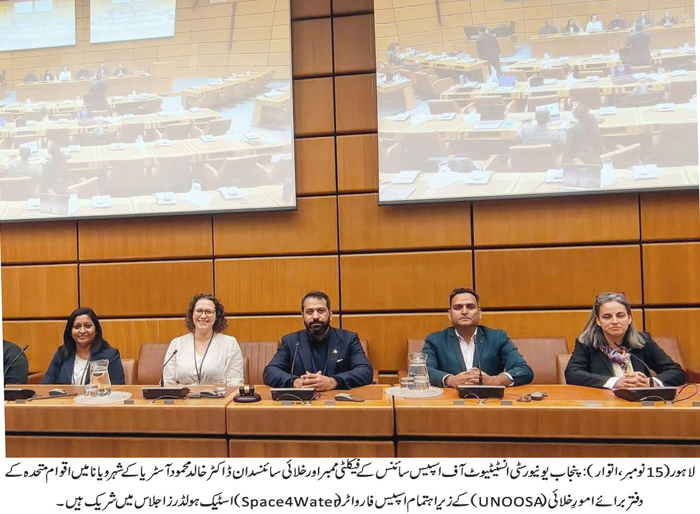
LAHORE: (Sunday, November 15, 2026): Punjab University Institute of Space Science faculty member Dr. Khalid Mahmood is participating in the Space4Water stakeholder meeting as Space Scientist, organized by the United Nations Office for Outer Space Affairs (UNOOSA), being in Vienna, Austria.
At the meeting, Dr. Mahmood presented work on rainwater harvesting, including a satellite-data-driven app for assessing runoff collection and identifying suitable locations for rainwater harvesting.

In his address, Dr. Mahmood focused on the gap between scientific research and its practical use in the developing world. He noted that poor decision-making in water management often stems from the absence of reliable scientific data, because ground-based data collection is expensive and is frequently the first item set aside when budgets are constrained. Satellite data offers a practical alternative—but, he argued, developing these alternative products is only half of the work. The models and datasets produced by scientists must be transformed into handy, user-friendly products—such as dashboards and mobile applications—so that users with minimal technical knowledge can compare options, weigh costs and benefits, and direct their limited resources toward the best available choice.
"The real value of our science comes when it reaches people as simple, handy tools they can use in their daily decisions," Dr. Mahmood said. "Alongside model development, we must take the additional step of making our work usable—so that a water manager, a farmer, or a householder can act on it with confidence."
He urged fellow scientists at the meeting not to restrict their work to model development and publication, but to carry it through to accessible, practical tools that communities can apply directly. He cited his group's rainwater harvesting app as an example of this approach in practice.
Dr. Mahmood's research focuses on satellite data–driven products as substitutes for costly in-situ datasets, and he is a strong advocate of international research partnerships and the co-development of scientific solutions.
The Space4Water project bridges the space and water sectors, supporting the use of space-based data to address global water challenges and advance the Sustainable Development Goals.