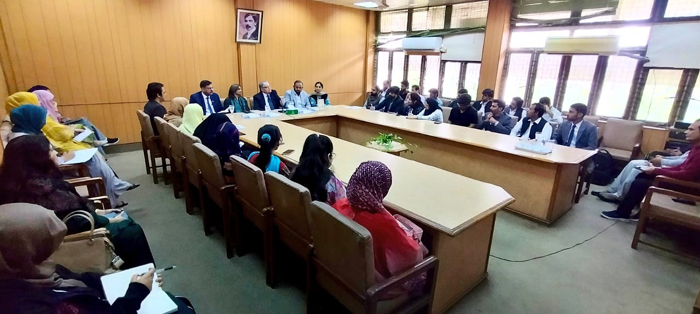
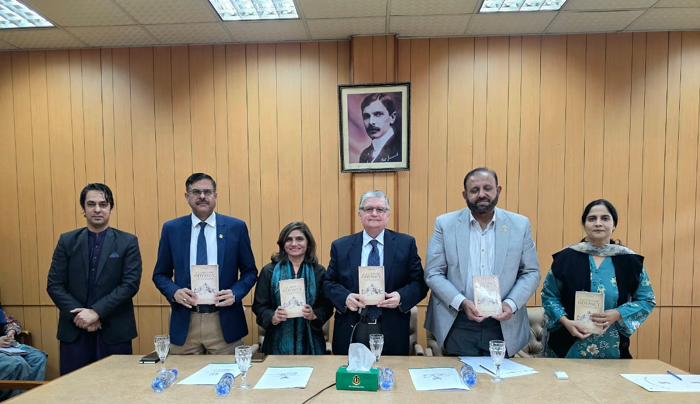
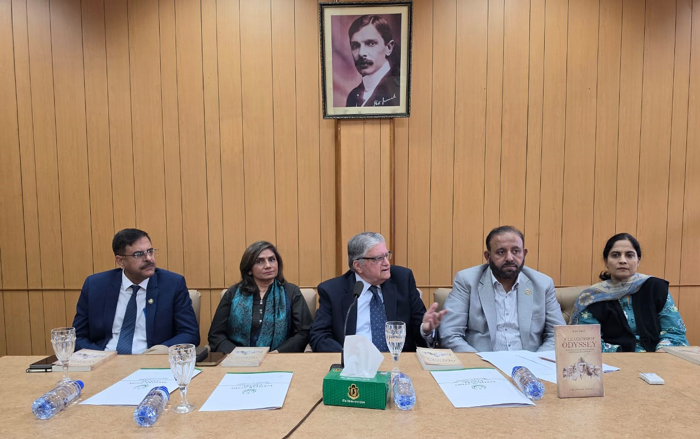
Lahore, November 23, 2026: Pakistan Study Centre, University of the Punjab, Lahore, organised an academic book talk on A Leadership Odyssey: Muslim Separatism and the Achievement of the Separate State of Pakistan (Oxford University Press, 2021/2024), authored by renowned historian Professor Dr. Sikandar Hayat. The event was also organised as part of the commemorations marking the 150th birth anniversary of Quaid-i-Azam Muhammad Ali Jinnah, providing an opportunity to reflect on his leadership and the historical struggle for the establishment of Pakistan. The event brought together distinguished academics, faculty members, researchers and students to discuss the historical evolution of Muslim separatism and the political leadership that contributed to the establishment of Pakistan. |
|
The session featured Professor Dr. Sikandar Hayat, Dean, Faculty of Social Sciences, Forman Christian College University, Lahore, as the keynote speaker. Distinguished guests included Prof. Dr. Mahboob Hussain, Dean, Faculty of Arts and Humanities; Prof. Dr. Rukhsana Iftikhar, Chairperson, Department of History and Pakistan Studies; and Prof. Dr. Naheed S. Goraya, Director, Centre for South Asian Studies, University of the Punjab. The proceedings were moderated by Dr. Chaman Hussain, Assistant Professor, Pakistan Study Centre, University of the Punjab. |
|
In his keynote address, Professor Dr. Sikandar Hayat presented the central arguments of his book, emphasising that Muslim separatism in British India evolved through a historical process shaped by religious and cultural differences, colonial constitutional arrangements, representative politics and the political strategies of Muslim leadership. He argued that the introduction of representative institutions based on numerical majority and minority divisions under British rule created significant political concerns for Muslims, who feared permanent political marginalisation in a Hindu-majority system of government. The failure of constitutional safeguards and the reluctance of Congress leadership to accommodate Muslim political demands further strengthened the separatist political movement. |
|
Tracing the historical development of Muslim political consciousness, Professor Hayat highlighted the contributions of six prominent leaders: Sir Syed Ahmad Khan, Aga Khan III, Syed Ameer Ali, Maulana Muhammad Ali, Allama Muhammad Iqbal and Quaid-i-Azam Muhammad Ali Jinnah. He explained how each leader contributed to advancing Muslim political interests at different stages. Sir Syed Ahmad Khan recognised the political implications of majority rule and encouraged Muslims to develop a separate political sphere. Aga Khan III played a significant role in establishing the All-India Muslim League in 1906, while Syed Ameer Ali contributed to strengthening Muslim political organisation through the London Muslim League and advocacy for separate electorates. Maulana Muhammad Ali highlighted the importance of Muslim-majority provinces in future constitutional arrangements, while Allama Muhammad Iqbal provided a philosophical and ideological foundation for Muslim political autonomy. Finally, Quaid-i-Azam Muhammad Ali Jinnah transformed the separatist political movement into the Pakistan Movement and led it towards the achievement of an independent state in 1947. |
A significant aspect of the keynote address was Professor Hayat's engagement with the historiographical debate between the primordialist and instrumentalist interpretations of Muslim separatism. Adopting an instrumentalist perspective, he emphasised the conscious, deliberate and purposeful role of Muslim political leadership in articulating and advancing the demand for a separate state. He explained that his book differs from conventional descriptive accounts by examining Muslim separatism through a collective leadership framework rather than focusing exclusively on an individual political personality. He also discussed the role of British and Congress leadership, whose political decisions and failures of accommodation influenced the development of Muslim separatism. |
During his address, Professor Hayat particularly encouraged students to develop a habit of reading books and engaging with authentic historical scholarship to understand the Pakistan Movement and the circumstances surrounding the creation of Pakistan. He emphasised that a deeper understanding of history requires students to go beyond prescribed textbooks and explore scholarly publications, historical evidence and diverse academic interpretations. |
The session was concluded by Prof. Dr. Amjad Abbas Magsi, Director, Pakistan Study Centre, University of the Punjab, who appreciated the participation of the distinguished speaker, guests, faculty members, researchers and students. He reaffirmed the Centre's commitment to promoting scholarly activities, historical research and meaningful academic discussions on Pakistan's history and political development. |
On the occasion, Oxford University Press (OUP) also established a bookstall at the Pakistan Study Centre, displaying its publications and offering a special 25% discount to participants. |
|