|
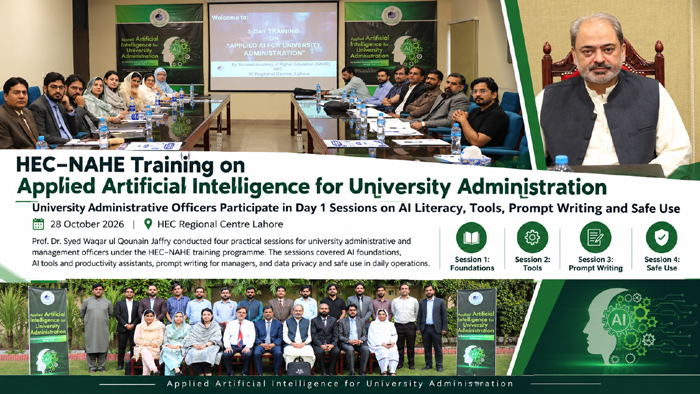
Prof. Dr. Syed Waqar ul Qounain Jaffry leads HEC–NAHE capacity-building initiative focusing on AI literacy, administrative productivity, effective prompting and responsible artificial intelligence adoption. |
LAHORE, 29 October 2026: Prof. Dr. Syed Waqar ul Qounain Jaffry, Chairman, Department of Information Technology, Faculty of Computing & Information Technology (FCIT), and Director, National Centre of Artificial Intelligence (NCAI-PU), University of the Punjab, conducted four specialised training sessions on the application of Artificial Intelligence (AI) in university administration at the Higher Education Commission (HEC), Regional Centre Lahore, on Wednesday, 28 October 2026. |
The sessions were delivered as part of the three-day professional development programme titled "Applied Artificial Intelligence for University Administration", organised by the Higher Education Commission in collaboration with the National Academy of Higher Education (NAHE). |
The initiative aims to enhance the professional capabilities of university administrative and management officers by equipping them with the knowledge and practical skills required to adopt artificial intelligence for improving institutional efficiency, administrative productivity, information management and service delivery. |
| Four Specialised Training Sessions |
Serving as the Resource Person for the first day of the programme, under the theme "AI Literacy, Strategy and Safe Use", Prof. Jaffry delivered four interconnected sessions designed specifically for administrative and management professionals working in higher education institutions. |
The first session, "AI and the Changing University: Foundations and Core Concepts", introduced participants to the fundamental principles of artificial intelligence, machine learning, deep learning, generative AI and emerging AI capabilities. It explained how these technologies are transforming administrative processes and creating new opportunities for universities. |
The second session, "AI Tool Landscape, LLMs and Productivity Assistants", explored contemporary AI platforms, large language models and productivity tools. Participants were introduced to practical applications involving official correspondence, document preparation, report writing, information retrieval, knowledge organisation and administrative decision support. |
The third session, "Prompt Writing for Managers", focused on developing effective communication skills for interacting with AI systems. Through practical demonstrations and guided exercises, participants learnt how to formulate clear and structured instructions to obtain more relevant, accurate and useful outputs for administrative tasks. |
The fourth session, "Data, Privacy and Safe Use in Daily Operations", addressed the responsible adoption of artificial intelligence in higher education. Key areas included information confidentiality, data protection, cybersecurity awareness, verification of AI-generated information, institutional accountability and the importance of human oversight in administrative decision-making. |
| Practical Training for Institutional Productivity |
A significant feature of the training was its interactive and application-oriented approach. Rather than focusing solely on theoretical concepts, the sessions incorporated practical demonstrations, hands-on exercises, realistic administrative scenarios, sample documents and guided problem-solving activities. |
Participants explored how AI could assist university offices in streamlining routine tasks, improving administrative communication, preparing reports, summarising documents and supporting knowledge-intensive activities. |
The exercises also demonstrated the limitations of AI-generated outputs and emphasised the need to verify information against authentic institutional records and applicable rules before taking official action. |
The training underscored that artificial intelligence should augment human expertise and improve organisational productivity without compromising professional judgement, confidentiality, institutional regulations or accountability. |
| Strengthening Pakistan's Higher Education Sector Through AI |
Prof. Jaffry appreciated the vision and leadership of the Chairman, Higher Education Commission, in promoting emerging technologies, professional capacity-building and digital transformation across Pakistan's higher education sector. |
He expressed gratitude to the HEC leadership and NAHE for providing an opportunity to contribute his academic and professional expertise towards national-level capacity-building. |
He also acknowledged the efforts of the HEC Regional Centre Lahore organising team and appreciated the enthusiasm, professional engagement and active participation of university administrative officers during the sessions. |
The training highlighted the importance of preparing university management professionals to understand the opportunities and challenges associated with rapidly evolving AI technologies and to introduce them responsibly into institutional workflows. |
| Continued Learning and Practical Implementation |
To support continued professional development, the training was accompanied by structured learning materials, including session presentations, participant workbooks, guided exercises, worked examples, administrative prompt templates, synthetic datasets and resources on AI governance and safe use. |
These materials are intended to help participants reinforce their understanding, independently practise AI-assisted administrative tasks and identify appropriate opportunities for responsible adoption within their respective institutions. |
The initiative represents a contribution towards strengthening AI literacy and practical digital competencies among university administrators in Pakistan. |
Through the participation of its faculty and research leadership in such national capacity-building activities, the University of the Punjab continues to contribute to the dissemination of advanced technological knowledge, the professional development of higher education personnel and the responsible application of artificial intelligence for institutional improvement. |